The guide that
remembers the film.
V AI is being built so that every step of a production reads and writes one record of your film: who is in it, what they wear, which hand holds the key, and what was approved and why. Today it is a prototype that drafts each step for a person to check.
Status, capability by capability.
| Capability | Status | What you can do | Limits and evidence | Next |
|---|---|---|---|---|
| Film commissions | Available service | We make music videos, short films and campaigns with captured and generated images, edited and graded in-house. Needs: A brief and a conversation about scope. | Scope, timing and price are agreed per project. Evidence: Five films released on YouTube since August 2026. | Commission a film → |
| Continuity pilot | Pilot by enquiry | For small hybrid teams getting revisions from several tools or people: one agreed scene or sequence, an approved reference record, person-reviewed findings with frames and timecodes, a correction list, and one review of the returned revision. Needs: The reel, or the scenes in question, and any references you have. | The automated check is not reliable enough to run alone, so a person reviews every flag. Offered as a scoped pilot. Evidence: The check has run on written cases and one real scene (see Research). | Ask about a pilot → |
| V AI prototype, 25 steps | Prototype | Runs in your browser. Drafts every step for your own film, from brief to release, and exports a workbook with one sheet per step. Needs: A free account on the AI platform it opens in. | Drafts only. Work is saved in that browser's local storage: it survives a refresh or closing the tab, but not a different browser or device, and clearing site data deletes it. No shared projects, approvals or versions yet. Each draft needs checking by a person. Evidence: Recorded run, 13 November 2026: a one-minute test film planned in 14 steps in about six minutes. | Try the prototype → |
| Script breakdown | Prototype | Reads a whole screenplay, scene by scene, into a stripboard with cast, props, wardrobe, effects and what continuity must hold, plus a production assessment and a CSV. Needs: The script as PDF, Word, Final Draft or text. | Not yet compared against a breakdown done by a first assistant director, so its accuracy is unmeasured. Evidence: Recorded run, 13 November 2026: 190 of 190 scenes of a 203-page screenplay read in about two and a half minutes, timed in the browser from sending the script to the finished stripboard. Reading every scene is not the same as getting every requirement right. | Try it in the prototype → |
| Continuity check | Prototype | Compares a new shot, described or as still frames, with the film's record, and lists possible breaks with a severity and a question for a person. Needs: The film's record and the shot to check. | Sees still frames, not motion. On its first real scene it raised false alarms. Not reliable on footage yet. Evidence: First real scene, 11 November 2026: 22 false alarms, then 8 after two fixes (see Research). | Read the results → |
| Saved projects, approvals, versions, teams | Planned | One saved record of the film that every step reads and writes, with approvals, versions and history. | Not built yet. | See the plan → |
| Open and local model deployments | Planned | The same workflows on open models running on a client's own machines. Needs: Suitable hardware. | In testing. No local model has passed our exam yet. Evidence: Exam, 11 November 2026: two untrained local models scored 16 of 37. | Read the results → |
| Learn AI with Videogrammer, one to one | Available service | Live sessions, one to one or for your group, booked when you need them: the latest AI tools for film and creative work, and how to put them to work in your job and your films. Needs: Who is learning, what you want to be able to do, and when. | Booked on request. Topics, length and fee agreed before each booking. No certificate. | Book a session → |
| AI Film School, 48-week programme | Planned | A programme built around six films each learner makes, from a silent point-of-view film to a crewed thesis film. | Written in full. Not open for enrolment; no cohort taught yet; not accredited. Dates and fees not announced. | Register interest → |
| V AI in school mode | Planned | Asks for the learner's attempt first, critiques their real work and records their authorship. | Not built yet. | Register interest → |
Status checked 13 November 2026. Available service: you can buy it now. Pilot by enquiry: we run it with you as a scoped pilot. Prototype: you can try it, it produces drafts, and it has limits. Planned: not built yet.
Your film stays yours.
Your IP is yours
Scripts, footage, music and every frame we make for you belong to the project. We never use client material to train models, and we never share it beyond what the work needs.
Private by design
For client work we choose the setup per project: enterprise-grade private deployments on Microsoft Azure, custom applications built around your studio, or models that run on your own machines.
Agreed before we start
Where your material is processed, who can see it and how long it is kept are written into the brief before any work begins.
The free V AI prototype is different: it runs on a third-party AI platform under your own account. Use it for ideas and test material, and bring confidential films to us for a private setup.
Can you spot the break?
Two shots from the same scene, filmed a week apart. Something changed. Two things, in fact. Click where you see them.
- Serious: the headscarf is orange; the record has it yellow since shot 1. Fix it, unless the change is scripted.
- Noticeable: Ravi took the cigarette in shot 2, so it should not be behind either ear in shot 4.
- Not checked: anything the shot did not show. It says so instead of guessing.
After fourteen hours on set, people miss the second one. A vendor who never saw shot 1 cannot catch either. V AI checks the new shot against what the film already established, and a person decides.
Today: the check runs in our prototype Prototype. Keeping each decision for the next shot is the saved record Planned.
Before, during and after the shoot.
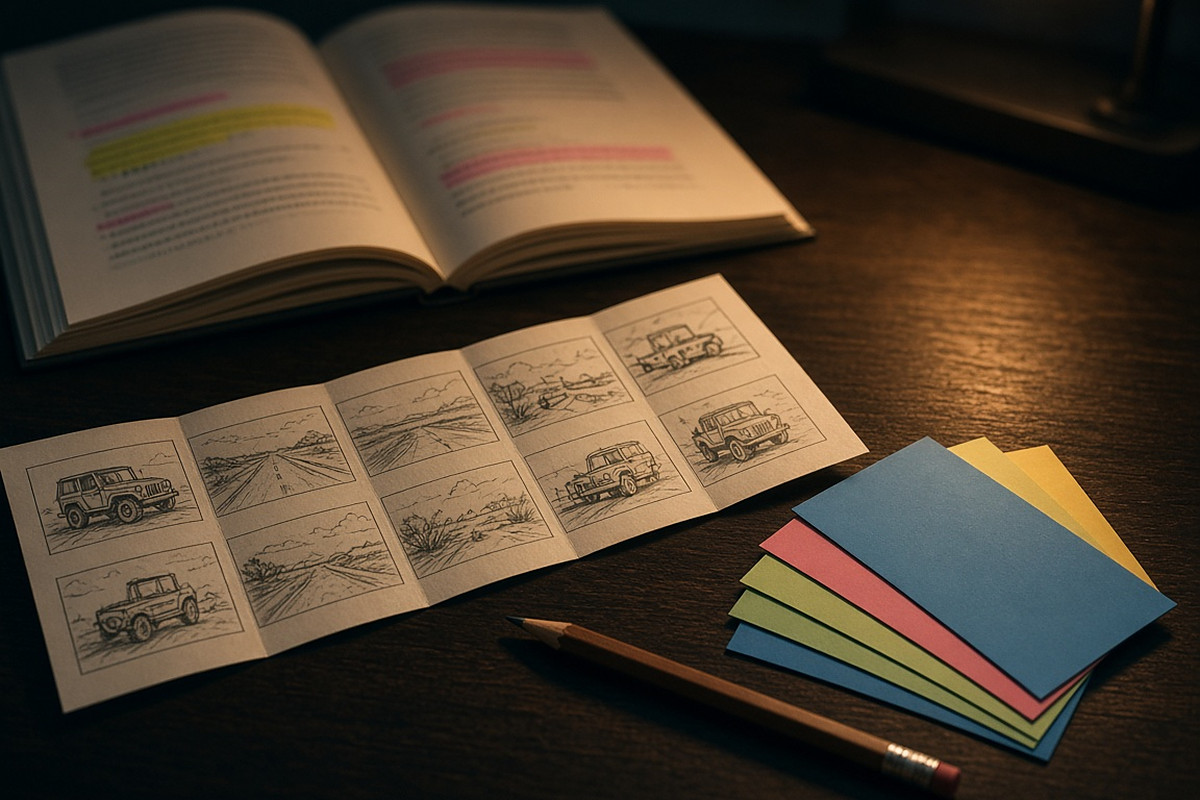
The scene hover an item to see where it came from
EXT. SALT FLATS - DUSK
ASHA (30s, yellow headscarf, silver ring on her left hand) drags a broken bicycle toward a parked jeep. RAVI (50s, khaki jacket, cigarette behind his right ear) leans on the bonnet, sun low behind him at frame right.
SHOT 1: wide, Asha small in frame left, jeep at frame right.
SHOT 2: medium on Ravi, he takes the cigarette from behind his ear.
SHOT 4: two-shot, he offers her water in a steel bottle.
What V AI drafted
And a question back: is the cigarette still there in shot 4? The script does not say, so it asked.
On the same day the step read all 190 scenes of a 203-page feature screenplay in about two and a half minutes. Its accuracy against a human breakdown has not been measured yet.
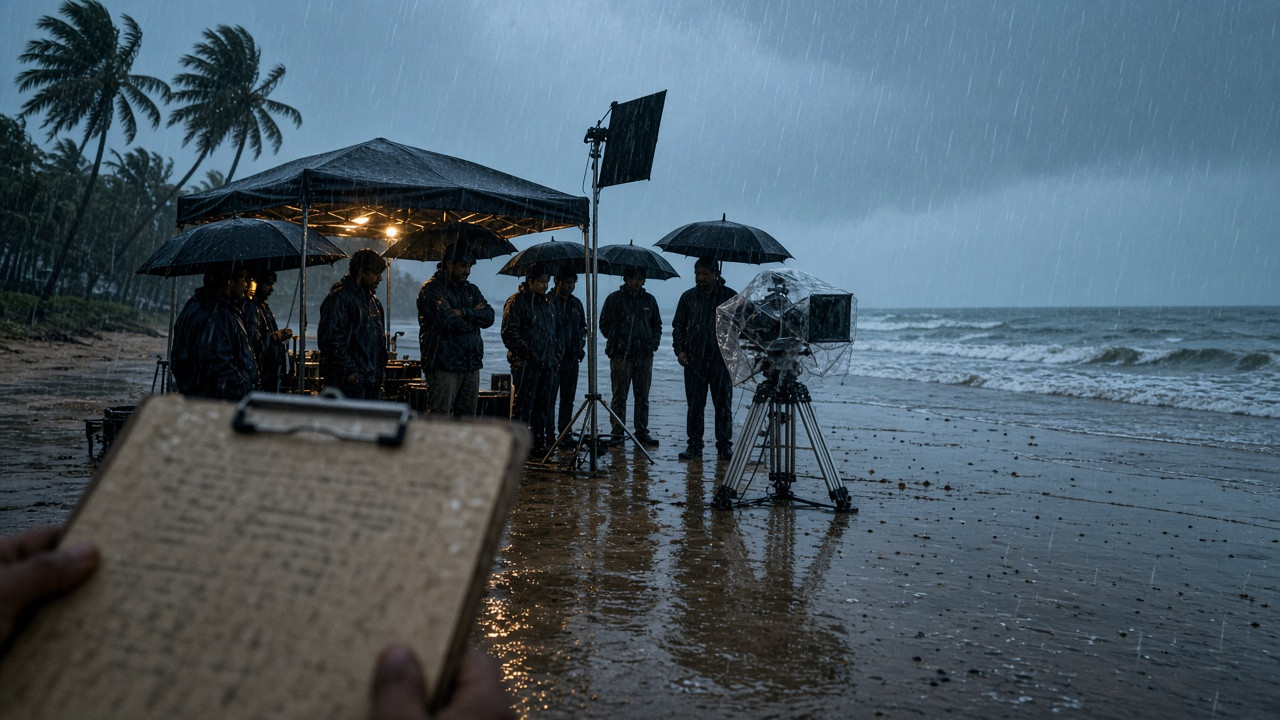
The approved day
| When | Scene | Where |
|---|---|---|
| Day 3, 07:30 | Sc 9–11, beach, exterior | Shore |
| Day 3, 14:00 | Sc 12, beach, exterior | Shore |
| Day 5 | Sc 14–15, cottage, interior | 8 minutes away, dressed |
Supplied Heavy rain from 10:40. The lead actor is free until 18:00.
Options proposed
| Option | Trade-off |
|---|---|
| A · Bring the cottage scenes forward to today | Beach scenes move to Day 5 morning Assumed free |
| B · Shoot the close-ups under the pier | Wides still owed; wet hair must hold into Sc 11 |
| C · Wrap | A day lost |
Unresolved Day 5 weather; the location permit for a changed date. The first AD picks one option, and a revised call sheet is drafted with the reason kept.
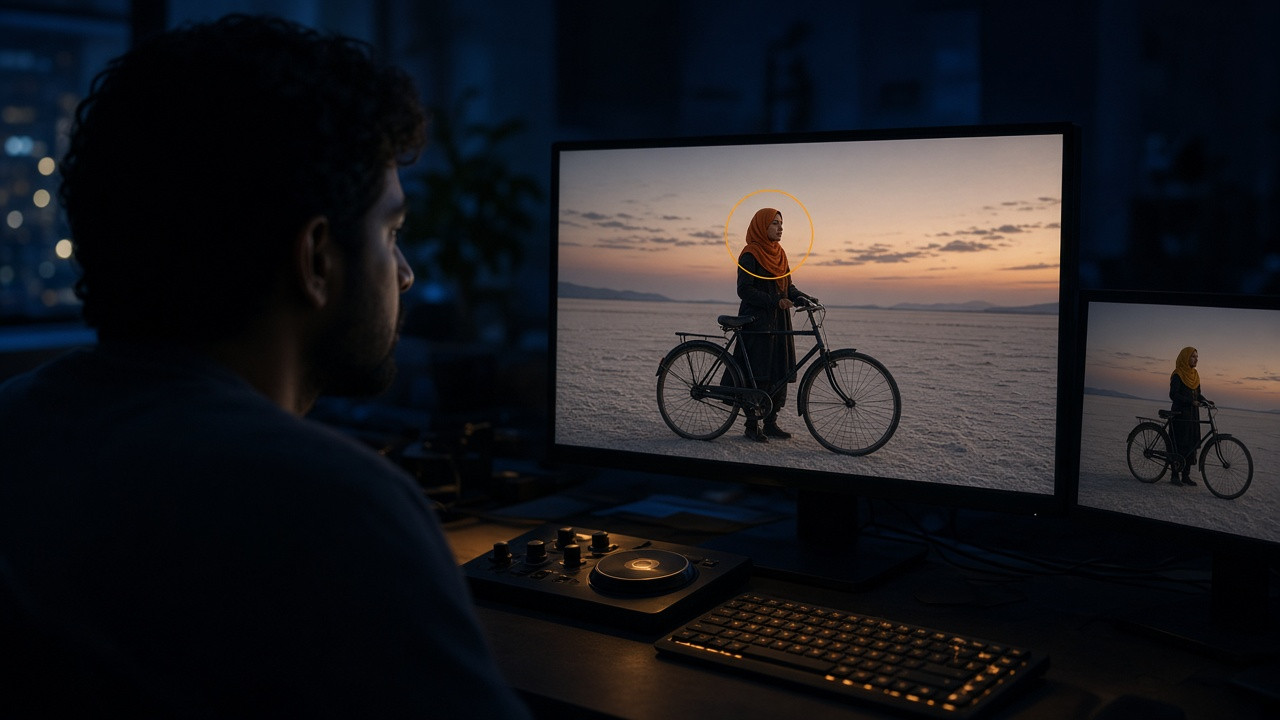
The question
A vendor delivers a new version of Ravi's medium shot. Does it still belong to the film?
What V AI reported
- Possible break, serious: Ravi's jacket reads dark charcoal; the record says khaki
- New, for you to approve: a blue band at the neck and a small white object, neither in the record
- Could not judge: the cigarette, the light direction, the jeep
- Its own caveat: one frame only; a second pair of eyes, not a verdict
Why it matters
The vendor who made the shot never saw the shots before it. The review compares against the record they never had. A person makes the call: a second model can share the first one's blind spots, so it never has the last word.
The check is a prototype and not yet reliable on real footage. Results are on the Research page.
A jacket tears in scene four.
Every later scene must show it torn. The flashback to the week before must show it whole. Switch between the three orders a film lives in, and watch each scene keep the right jacket.
 Scene 1Market morningWholeScene 2The argumentWholeScene 3The roadWholeFlashbackThe week beforeWhole
 Scene 4The fight: it tearsTornScene 5The hospitalTornScene 6HomeTorn
The tiles show what the saved record is being built to do Planned. Pre-production, production and post-production are the stages; these are the timelines the record keeps apart.
The 25 steps.
Each step is one filmmaking problem with a workflow behind it. In the prototype every step produces a draft for a person to check.
Pre-production
01Project brief
The problem. A project starts without anyone writing down what it is, for whom, how long, and with what money.
What V AI drafts. Pins the format, length, audience, platform, budget level and way of making it, then decides which steps this project needs and which to skip.
02Story
The problem. The story lives in one head. Everyone downstream works from a different version of it.
What V AI drafts. Completes the story in the international development format: title, logline, characters, world, acts, beat sheet and a one-page synopsis.
03Screenplay
The problem. A story is not yet a plan. Until it is in scenes, nothing can be scheduled, costed or shot.
What V AI drafts. Turns the story into a scene outline, then writes every scene in standard screenplay form, as a draft for the writer to rewrite.
04Script breakdown
The problem. A script is read by twelve departments, and each keeps its own list.
What V AI drafts. Reads the script and drafts the film's record: people, costumes, props, places and light, and the scene where each first appears.
05Look and cast lock
The problem. Each tool and each vendor starts from its own picture of the character.
What V AI drafts. Drafts one approved look for each face, costume and place, for generators and vendors to start from.
06Previs and shot plan
The problem. The shot list lives in one head and the storyboard in another.
What V AI drafts. Turns the scene into a shot plan, and says which shots a camera should take and which a generator can.
07Budget
The problem. Money is guessed late and line by line, and the expensive scenes are found after they are scheduled.
What V AI drafts. Builds a top sheet and line budget from the breakdown at the brief's budget level, and names the scenes that drive the cost.
08Schedule and risk
The problem. The fragile days are found on the day they break.
What V AI drafts. Reads the schedule against cast dates, locations and weather, marks the days most likely to break, and holds a cover plan for each.
09Crew and locations
The problem. Crew and places are booked from memory, and the gaps appear on the first day.
What V AI drafts. Lists the crew this project needs at its scale, and every location with what it must provide, permits and a backup.
10Tools and vendor plan
The problem. Tools are chosen shot by shot, and later nobody can say which made what.
What V AI drafts. Sets which tool or vendor makes each shot. The tools already in use come first, then they are connected, and custom code comes last.
Production
01Call sheets
The problem. Each night someone rebuilds tomorrow by hand from the schedule, the cast list and the weather.
What V AI drafts. Turns the schedule into a call sheet for every shoot day: scenes, cast, calls, locations, special needs.
02Generated shots
The problem. Generated shots are made one prompt at a time, by different people, from different pictures of the character.
What V AI drafts. Drafts the generation plan for each generated shot: the prompt, the reference it starts from, and what continuity it must hold.
03The day breaks
The problem. Rain stops the shoot. The unit waits, the day is lost, and the schedule is rebuilt by hand overnight.
What V AI drafts. Re-solves the day against cast dates, locations and what is already shot, proposes a cover scene and drafts the new call sheet.
04On-set continuity
The problem. Costume and props drift between days. The script supervisor holds it all in notes and photos.
What V AI drafts. Checks each setup against the film's record before the camera rolls.
05Coverage check
The problem. A missing angle is found at rushes the next day, after the unit has left the location.
What V AI drafts. Checks the takes against the shot plan beside the set, and flags the gap before the unit moves.
06Location sound
The problem. Unusable location sound sends the scene to dubbing weeks later.
What V AI drafts. Reads the sound report the same night and lists only the lines that cannot be saved.
07Rushes overnight
The problem. Rushes pile up. The director sees selects days later.
What V AI drafts. Logs a day's takes by scene and take from your notes, and proposes a first assembly order.
Post-production
01Edit assist
The problem. Finding the take with the right line eats the editor's day.
What V AI drafts. Finds takes by what is said and done in them, and builds string-outs for the editor to cut from.
02Continuity check
The problem. A shot is regenerated by a second vendor. Nobody on that team has seen the rest of the film.
What V AI drafts. Compares a new shot with what the film's record holds, shows each possible break beside the shot that set it, and leaves the decision to a person.
03Vendor turnover
The problem. Three vendors deliver the same character. Each one matches its own reference.
What V AI drafts. Drafts each vendor's turnover note with the record entries it needs, and the checks the delivery should pass.
04Sound, music and dub
The problem. Every language version is rebuilt by hand, and lines drift from the picture.
What V AI drafts. Keeps one list of lines across languages and marks where a dub no longer fits the cut.
05Colour grade
The problem. The look drifts from shot to shot, and generated shots never match the camera.
What V AI drafts. Sets the look of each sequence and the rules that make generated and camera shots sit together.
06Titles and credits
The problem. Credits are typed at the last minute, and names are wrong or missing.
What V AI drafts. Writes the main title design brief and the credit order from the brief, cast and crew.
07Lock, grade and delivery
The problem. A change arrives after picture lock. Conform, effects, sound and every version are redone by hand.
What V AI drafts. Lists the versions a late change touches, and drafts the delivery trail for each AI shot.
08Release and marketing
The problem. The film is finished before anyone plans how people will find it.
What V AI drafts. Plans the release: trailer beats, poster idea, loglines for each platform, festivals or channels, and a launch timeline.
What the record will hold.
Observed
What V AI saw in a frame or read in a file, and where.
Proposed
What it inferred or suggests, never treated as fact until approved.
Approved
What the filmmaker decided, by whom and when.
Unknown
What could not be seen or was never given, said out loud.
Changed on purpose
A jacket torn from scene four on; the flashback keeps it whole.
Three timelines
Story time, shooting order and edit order, kept apart.
Planned Saved records, approvals and versions are being built.
A step's raw output.
What it shows
Drafting: five sentences turned into the international development format, with a list of exactly what V AI added, so the filmmaker can see which ideas are theirs. Useful, but any chat assistant can draft; the handoff example on the homepage shows what memory adds.
Excerpts
- Logline: On the last night before his lighthouse is automated, an old Kerala keeper who has burned his lamp for forty years for a son lost at sea keeps it alive through a storm to guide home a small boat he cannot name.
- Character: Raghavan: Protagonist, the lighthouse keeper. Late 60s. Lean, weathered, white stubble, faded khaki shirt and mundu, brass-rimmed glasses, hands scarred from years of lamp work.. Wants: To keep the lamp burning one last night, as he has every night, in case his son returns.. Needs: To accept the loss and let his vigil become a gift to others, so he can let go.. Arc: From a man clinging to a hopeless wait, to one who understands the light was always meant to bring someone home, and finally rests.
- Act 1 (0:00-0:15): The Vigil: Dusk. Raghavan climbs the lighthouse stairs and lights the lamp, as he has for forty years. A faded photo of his son sits by the lamp, and beside it a notice: the lighthouse will be automated after tonight. He looks to the empty sea.
See the full, unedited output (33 rows)
| Title | The Last Light |
| Logline | On the last night before his lighthouse is automated, an old Kerala keeper who has burned his lamp for forty years for a son lost at sea keeps it alive through a storm to guide home a small boat he cannot name. |
| Genre | Drama |
| Tone | Quiet, aching, ultimately consoling; hushed and elegiac, with a swell of hope at the end. |
| Theme | Love outlasts loss when it becomes service to others; a vigil kept for one can save many. |
| World | The Kerala coast at dusk and night: a weathered whitewashed lighthouse on a laterite headland, coconut palms bent by wind, a small fishing harbour with wooden boats, monsoon-edged sea. Intimate keeper's quarters with an oil lamp, a faded photograph and a folded work order. Vertical 9:16 for Instagram Reels, Malayalam with minimal or no dialogue and English subtitles if any speech. |
| Character: Raghavan | Protagonist, the lighthouse keeper. Late 60s. Lean, weathered, white stubble, faded khaki shirt and mundu, brass-rimmed glasses, hands scarred from years of lamp work.. Wants: To keep the lamp burning one last night, as he has every night, in case his son returns.. Needs: To accept the loss and let his vigil become a gift to others, so he can let go.. Arc: From a man clinging to a hopeless wait, to one who understands the light was always meant to bring someone home, and finally rests. |
| Character: Anil | The lost son, seen only in a photograph and memory. Early 20s in the photo. Smiling young fisherman, wet hair, striped shirt, standing by a wooden boat.. Wants: (Absent) To come home.. Needs: (Symbolic) To be remembered with peace, not only grief.. Arc: Remains a memory; his presence is echoed in the boat that arrives. |
| Character: The young boatman | Unnamed fisherman in the small boat, glimpsed at the end. Around 20s. Silhouetted figure in a rain-soaked shirt, lantern in hand, raising an arm in thanks.. Wants: To survive the storm and reach harbour.. Needs: A guiding light.. Arc: From lost in the dark to safe ashore, standing in for the son who never returned. |
| Act 1 (0:00-0:15): The Vigil | Dusk. Raghavan climbs the lighthouse stairs and lights the lamp, as he has for forty years. A faded photo of his son sits by the lamp, and beside it a notice: the lighthouse will be automated after tonight. He looks to the empty sea. |
| Act 2 (0:15-0:45): The Storm | Wind and rain rise. The power flickers and the lamp falters. Midpoint (~0:30): through the rain, tiny boat lights appear on the horizon, tossed by the waves. He doesn't know whose boat it is. He shields the flame, cranks and tends the lamp by hand, hands shaking, while the beam sweeps the water. |
| Act 3 (0:45-1:00): The Harbour | The boat reaches the harbour. A young man steps ashore and raises a hand toward the light. Raghavan, exhausted, smiles, touches the photograph, and the dawn breaks as the lamp goes dark for the last time. Final image: the sunrise, the old keeper at peace. Title card: The Last Light. |
| Beat: 1. Opening image (0:00) | Wide vertical shot of the lighthouse at golden dusk, waves below. |
| Beat: 2. The ritual (0:05) | Raghavan climbs the spiral stairs and lights the lamp. |
| Beat: 3. The photograph (0:10) | Close on Anil's photo beside the lamp. |
| Beat: 4. The notice (0:14) | The automation notice: last night. Raghavan folds it away. |
| Beat: 5. Storm gathers (0:18) | Dark clouds, wind through the palms, waves crash. |
| Beat: 6. Lamp falters (0:24) | Power flickers; he steadies the flame by hand. |
| Beat: 7. Midpoint: lights on the horizon (0:30) | Small boat lights appear in the rain. He doesn't know whose they are. |
| Beat: 8. Decision (0:35) | He rejects the thought of leaving the lamp and commits to keeping it burning. |
| Beat: 9. The struggle (0:40) | The boat is tossed by waves while the beam sweeps; he tends the lamp, exhausted. |
| Beat: 10. Reaching the harbour (0:47) | The boat slips past the rocks into the harbour. |
| Beat: 11. The thank-you (0:51) | A young boatman lifts his hand toward the light. |
| Beat: 12. Release (0:54) | Raghavan smiles, touches the photograph, and lets the lamp go dark at dawn. |
| Beat: 13. Final image and title (0:57) | Sunrise over calm sea; title card: The Last Light. |
| Synopsis | (empty in the exported sheet) |
| Added by V AI | Genre, tone, theme and world description |
| Added by V AI | Character names (Raghavan, Anil), looks, ages, wants, needs and arcs |
| Added by V AI | Three-act structure with timings and midpoint |
| Added by V AI | 13-beat sheet fitted to one minute |
| Added by V AI | Full synopsis and production notes |
| Added by V AI | The young boatman figure and the dawn ending image |
| Added by V AI | Title kept as given in the brief |
Four ways, compared plainly.
| Way of running the AI | Quality | Cost | What leaves your machines | Hardware and upkeep | Available today |
|---|---|---|---|---|---|
| One frontier model | Strong drafts. It knows only what the project record gives it | Pay per use | What you send goes to the model provider | None | Prototype in the V AI prototype |
| Several frontier models | Each job to the model best at it; a separate review step, with a person deciding | Higher per use | Sent to each provider used | None | Planned |
| Open models taught by the frontier | Must pass our exam first; none has yet | Hardware and training | Can run inside your network, depending on how it is set up | Your machines; regular updates | Planned in testing |
| Open source only | Weaker today on some jobs | Hardware and upkeep | Can be set up with no outside connection; we confirm the network setup with you | Your machines; most upkeep | Planned |
Open models are not private by default. Privacy depends on the network setup, which we document for each installation.